
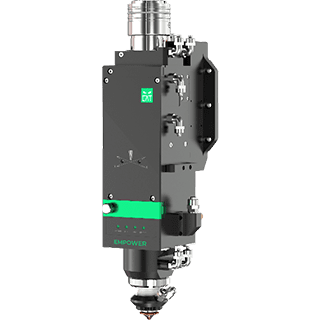
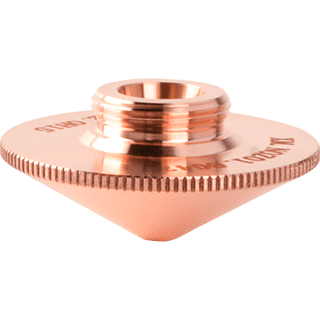
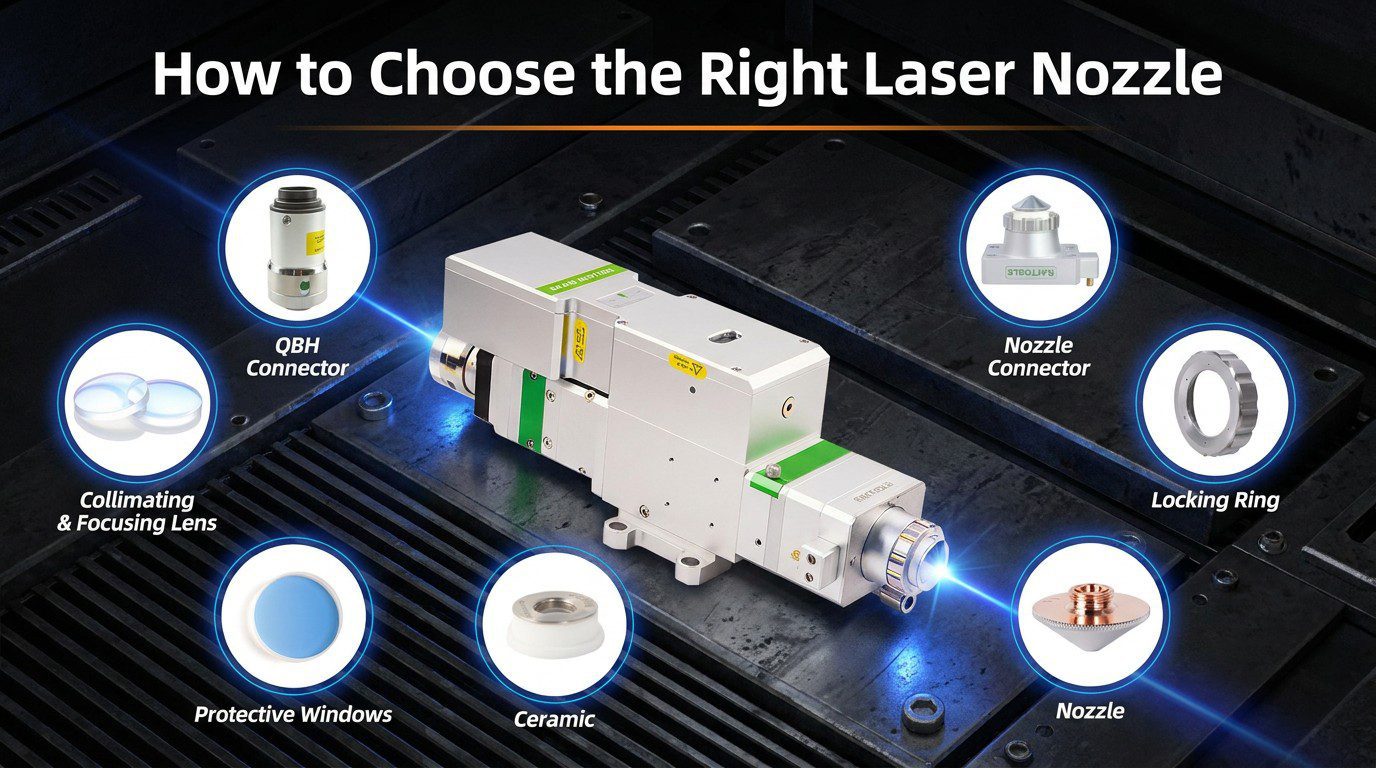
The right laser cutting nozzle must match both the cutting head and the cutting process. A familiar shape, a matching outside diameter or the words “single layer” do not establish compatibility. Start with the head identification and the complete nozzle specification, then confirm the process settings recommended for your machine.
1. Identify the cutting head before selecting a nozzle
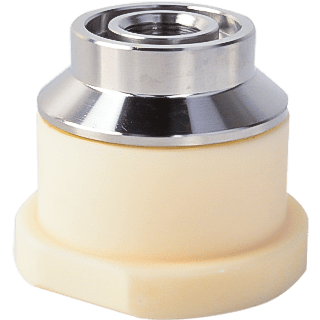
Record the manufacturer, exact head model and version shown on the nameplate. Keep the old nozzle’s part number or packaging when available. A photograph of the nozzle helps identify its structure, but it should accompany dimensions rather than replace them.
Compare the outside diameter, overall height, thread diameter and pitch, nozzle opening and seating geometry. A diameter-height-thread description is useful for narrowing a search; it is not a complete engineering drawing. Never force a nozzle into a thread that does not engage normally.
2. Similar dimensions can hide different structures
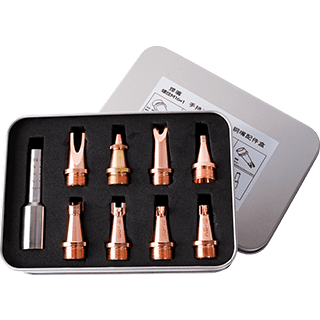
Two nozzles can look similar or share one measurement and still differ in the opening, thread or pitch, seating geometry, or internal construction. Check the exact part reference and the cutting-head manufacturer’s documentation before choosing a replacement. Appearance, one matching dimension, or the words “single layer” and “double layer” do not confirm compatibility or cutting use.
3. Record nozzle dimensions before ordering
Use the original part reference and exact cutting-head model first. If those are unavailable, record the details below from the existing nozzle or its drawing. A matching outside diameter alone does not confirm compatibility.
| Check | What to record and send |
|---|---|
| Outside diameter | Record the dimension and units shown on the drawing. The outside diameter of the D28 nozzle is confirmed as 28 mm; this does not confirm its other dimensions or compatibility. |
| Opening / bore | Record the specified opening size and units. Send the part marking or manufacturer drawing; do not estimate it from a photo. |
| Overall height | Record the height and the measurement reference points. A side-view photo beside a scale or a drawing is useful. |
| Thread | Record the documented thread designation and pitch. Send the drawing, original part number or packaging label. |
| Seat and construction | Record the seating shape and any documented single-layer, double-layer or other construction. Send top, side and underside photos. |
| Head and part reference | Record the exact cutting-head model/version and original nozzle reference. Send the nameplate and part label when available. |
Use this checklist to identify a part, not to choose cutting parameters. Verify the nozzle opening and process settings against the equipment manufacturer’s documentation for the actual job.
Browse the laser nozzle range or send the information through our nozzle inquiry form for a specification check and quotation.
4. Select the opening for the actual cutting job
Provide the material grade, sheet thickness, assist gas and intended process when asking for an opening size. Use the machine or cutting head manufacturer’s parameter guidance as the starting point. There is no single bore size or gas pressure that this guide can recommend for every machine and material.
When evaluating a replacement, compare results on representative material using an approved setup. Record the nozzle code, opening, gas and relevant machine settings so that a successful result can be repeated. Change process variables in a controlled way.
5. Inspect before blaming the nozzle specification
A damaged opening, contamination or an incorrectly seated part is a reason to inspect the assembly. Poor cutting alone does not prove that the nozzle type is wrong: gas supply, alignment, focus, material condition and other machine factors may also need checking. Follow the manufacturer’s isolation and inspection procedure and have a qualified technician investigate persistent problems.
What to send with a nozzle inquiry
- Cutting head nameplate photo and exact model/version.
- Existing nozzle code, front and side photos, and available drawing.
- Outside diameter, height, thread diameter and pitch, and bore size.
- Single/double-layer or other internal design, plus required finish.
- Material, thickness, assist gas and the reason for replacement.
To request a replacement, send the cutting-head model, original nozzle reference, clear photos and required quantity through our nozzle inquiry form. The site currently accepts inquiries only; online payment and shipping are not available. Confirm the specification and order terms before ordering.
Frequently asked questions
Can two nozzles with the same dimensions be interchanged?
Not on dimensions alone. The connection, seating geometry, internal design and head-specific requirements must also match.
Will a new nozzle solve every cutting-quality problem?
No. Inspect the existing nozzle and check the wider process before concluding that a replacement is the solution.